

One House, Two Families: Seeing the Weight We Carry
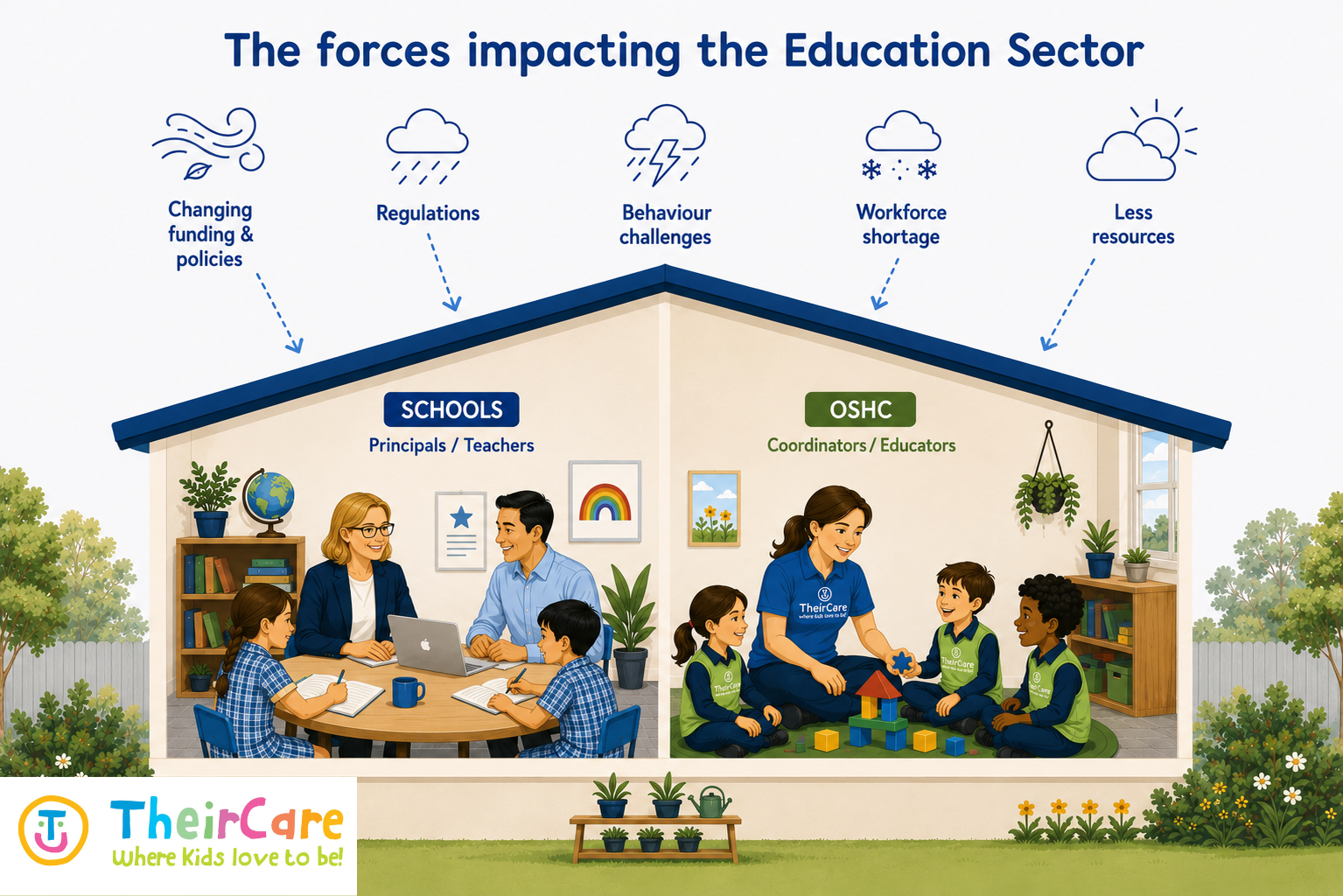
In our previous article, Shared Culture of Care Under a Bigger Roof: One House, Two Families, we explored how schools and OSHC can work together to notice the quiet signals children give us. Through trust, communication, and shared responsibility, we reflected on the importance of seeing more of the picture and supporting children before small concerns become larger challenges.
Yet children are not the only people living under the roof.
Sometimes the quiet signals come from the adults who care for them. A teacher may not see the staffing pressures facing an OSHC service. An educator may not see the competing demands placed on a principal. Families may not see the countless decisions being made behind the scenes to support children each day. Yet these invisible pressures shape the experience of everyone involved in supporting children.
Across Australia, educators are supporting children through increasingly complex
circumstances. Behavioural challenges are rising. Workforce shortages continue across the sector. Compliance requirements are growing, while expectations from families and communities remain high. At the same time, many services are being asked to do more with less.
Despite these pressures, children still arrive each morning and afternoon looking for connection, encouragement, belonging, and care.
The remarkable thing is not that challenges exist. It is that so many educators continue to show up every day determined to make a positive difference in the lives of children. These challenges are often discussed through the lens of funding, regulation, staffing, and systems. While these conversations matter, they can sometimes overlook the people at the centre of them.
Behind every service, classroom, and program is a person. Someone carrying responsibilities that rarely appear in reports, policies, or headlines. A teacher helping a student navigate a difficult period of life. An educator supporting a child whose needs have become increasingly complex. A coordinator reworking rosters to ensure children continue to receive quality care. A principal balancing the needs of students, families, staff, and the wider community.
These are not simply job descriptions. They are daily acts of care.
The challenge is that much of this work remains invisible. We tend to notice problems when they emerge, but rarely pause to recognise the thousands of small decisions, adjustments, and acts of commitment that prevent problems from occurring in the first place. Perhaps this is where understanding becomes most important. Not because everyone experiences the same challenges. Not because every role carries the same responsibilities.
But because healthy relationships are built on understanding, not assumptions.
Strong communities are not those without challenges. They are the ones that recognise when people are carrying a heavier load and choose to respond with support rather than judgement. Children flourish when the adults around them flourish. When educators feel supported, they are better able to support children. When partnerships are built on trust, communication, and understanding, communities become stronger. And when we take the time to understand the pressures faced by those around us, we create environments where people feel seen rather than overlooked.
Every community shares the responsibility of helping children grow.
Every house needs maintenance. When a roof begins to leak, most people notice the water on the floor. Fewer notice the pressure building above the ceiling. The same can be true in our communities. The visible challenges often attract our attention, while the unseen pressures quietly accumulate in the background.
Flourishing begins when we notice both.
Perhaps one of the most important things we can offer each other is not a solution, but an acknowledgement. An acknowledgement of the effort. An acknowledgement of the responsibility. An acknowledgement that caring for children has never been the responsibility of one person, one organisation, or one family alone.
We share both the rewards and the challenges.
When we choose understanding over assumption and partnership over criticism, we strengthen the communities that children depend upon.
Because sometimes the people working beside us are carrying more than we realise. And sometimes, simply taking the time to understand is where care begins.